- The Woof
- Posts
- How Pet Brands Are Actually Being Discovered
How Pet Brands Are Actually Being Discovered
Why ranking, PR hits, and paid ads alone don’t explain modern visibility.

Collin Armstrong
December 17, 2025

Issue #281
December 17, 2025
Quick Hits:

Pet brand founders often silo their marketing into SEO vs. PR vs. paid vs. social, thinking each channel operates in isolation.
The reality is consumers experience discovery as an integrated journey, and the platforms facilitating that journey no longer wait for explicit instructions.
What does that mean?
For years, founders were taught that discovery hinged on explicit inputs. Create content explicitly for commercial intent keywords, how-to queries, "near me" phrasing (if you’re a local business) across web and social.
That mental model no longer reflects how discovery systems actually work. Today, platforms assume context by default. Location is inferred. Category intent is inferred. Urgency is inferred.
A search for "best vet," "emergency vet," or even just "vet" now triggers a full local decision engine without the user needing to qualify anything.
The query is no longer the instruction, it's the starting point.
What determines visibility isn't whether a user typed the right modifier. It's whether the brand or service has accumulated enough signals — authority, reviews, mentions, engagement, and presence — to be chosen by the system.
Discovery hasn't broken; it's evolved into a signal-based system where Google, social media, review sites, and LLMs connect dots between trust and relevance to surface what matters.
The End of Keyword-Stuffing
Google now automatically applies local intent for queries it deems location-based (so does Chat GPT, Claude, etc,). Search for "best groomer for dogs" and you'll trigger a map pack of nearby groomers without specifying a city.

What's changed is how platforms decide which results to show.
Google's ranking systems ( 👈️ if you want to hear it straight from big G’s mouth) consider many factors beyond query text — including source expertise and authority, user context like location, content freshness, and engagement metrics.
In pet brand discovery, compound signals have become the new currency.
Authority comes from brands cited by credible sites or sources like vets for instance. Reviews and ratings boost visibility, especially locally.
NOTE: having good reviews that mention keywords which pertain to your services, can sometimes deliver a big lift the local map search results - example below 👇️

The search query “vet for senior dogs” gave me a local vet which specifically had a client review mention taking care of their ‘senior dog’
Engagement matters when people actually click, linger, or discuss a brand.
Freshness gives preference to content that stays current or brands that stay in the news. Even paid presence, while not a direct ranking factor, shapes discovery by occupying prime screen real estate and reinforcing brand familiarity.
This local dog daycare occupies the first set of search result pixels with a sponsored link and then again with their sponsored Google Business Profile.
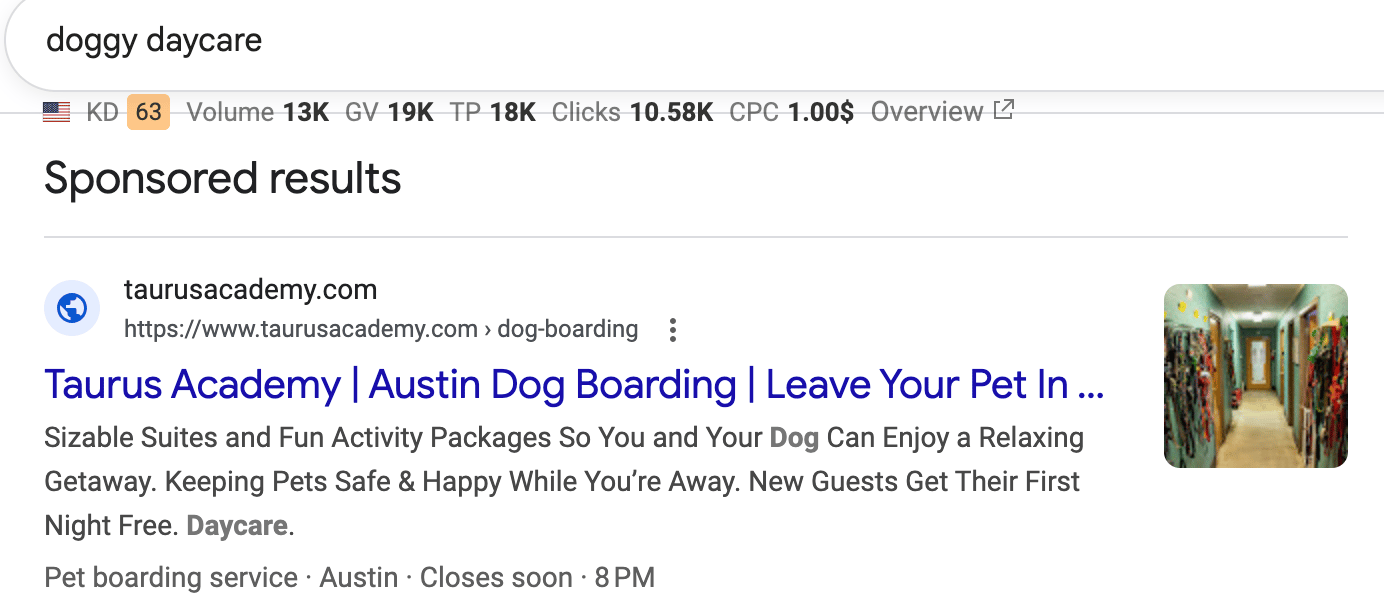
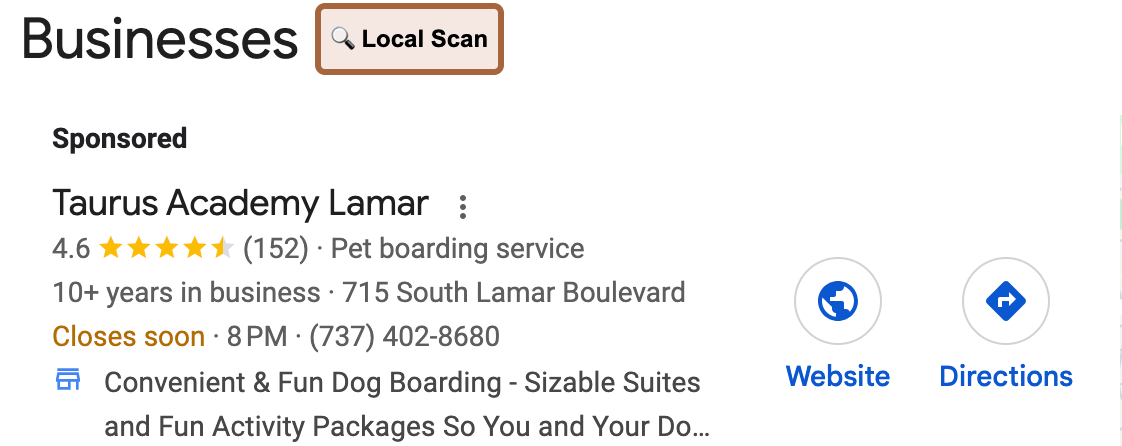
Discovery now revolves around trust signals and contextual relevance, not just keyword matches meant to boost your organic ranking prowess.
Why Evergreen Editorial Dominates Pet Product Searches
When pet owners search long-tail questions like "best dog food for senior dogs" or "best calming treats for dogs," the top results are almost always evergreen listicles.
These "Top 7" or "Best 10" articles by pet sites persist for years in the rankings because savvy publishers keep one canonical page and refresh it annually instead of churning out new pages for every year or trend.

Even the top sponsored links are listicles.
PetMD's "Best Foods for Senior Dogs" article — owned by pet retailer Chewy — is a single URL updated as recently as January 2025.
Each year, they swap in newer formulas or brands, tweak recommendations, and update the title. This refresh cycle means the page retains its accumulated backlinks and authority while staying relevant.

Their articles consistently rank first in the organic search results for many “best X” keywords, but over the years this result has become deeply buried past the page break due to AI overviews and PPC
These evergreen editorials dominate pet product queries for several reasons.
Consumers and Google see listicles from known pet media or vets as curated, less biased recommendations rather than outright ads.
Queries like "best dog food for allergies" aren't fads — new pet parents ask them every day, so interest remains steady over time. Being featured in these "best" lists isn't a one-off PR win; it's reputation infrastructure.
Each mention is an authority signal. The more a pet food appears across trusted "Top X" lists, the more its brand authority compounds in search algorithms and in consumers' minds.
Because these URLs are evergreen, they accumulate backlinks and age, making them hard to dislodge.
Competing brands (or pubs) have to unseat the article, not just one another. Brands jockey within these articles through outreach (many for $$) or merit to get included or ranked higher, rather than trying to outrank the article itself.
In pet discovery, editorial content acts as a persistent filter that frames which brands are even in the consideration set.
Services Discovery Happens in Layers
For local pet services — vets, groomers, pet sitters, doggy daycares — discovery is heavily layered.
A pet owner's query like "emergency vet" or "dog groomer" might seem generic, but Google knows it's loaded with urgent local intent. The user likely didn't bother typing "near me" or a city because they assume their phone will handle that.
In the event that you are in an emergency situation and want to provide more context for the “type” of emergency situation you might be in, then LLMs are going to be better than Google at taking that into consideration to deliver you hyper specific results…

ChatGPT’s response to a contextual long-tail search query
Google prioritizes locally optimized businesses for these searches, using the searcher's geo-location by default.
Paid ads come first.
The very top slots are often Google Ads or Local Services Ads that grab immediate attention, though savvy users know they're sponsored.
Just below ads, the Map Pack dominates — usually the top three local clinics or businesses with map, ratings, and hours.
Google (and LLMs) will even take your local time into consideration when showing Map Pack results to only show you business that are open during your active search. Many businesses try to game the system by claiming to be open 24/7 just to avoid missing out on any potential traffic outside of their hours of operation.
SEO experts frequently cite that clinics with high ratings and frequent positive reviews tend to rank higher in the local pack, especially businesses that respond to each review, good or bad.
Proximity, Google Business Profile completeness, and review ratings are key factors.
Below the map, organic links appear.
Often it's aggregators or editorial "Best vets in [City]" lists from sites like Yelp, local publication, or Reddit threads.

A Reddit post from 2 years ago ranks no.1 in the organic results
These editorial lists provide social proof beyond Google's own reviews.
At every layer, reviews and ratings shape discovery.
In one survey, 55% of Millennials and 63% of Gen Z said they favor results with positive reviews over just a compelling headline. Reviews on Google, Yelp, or Facebook also act as content that Google crawls. Frequent mentions of "gentle with cats" or "affordable vet" under a clinic's profile can boost its relevance for those keywords.
All these pieces reinforce each other. A local pet groomer with ads up, a spot in the map pack, a mention in the city's "Best Groomers" article, and glowing reviews is going to win more clicks than a competitor who only checks one box.
Services discovery is a layered trust system built by visibility plus social proof.
Two Parallel Discovery Engines
The rise of social media as a search platform has created two parallel discovery engines.
Search-native users who turn to Google first for information, and social-native users who go straight to TikTok, Instagram, YouTube, or Reddit to research a product or service.
These behaviors reflect different questions.
Google is great for answering "What's the most established or authoritative option?" Google will tell you the vet that's been around 20 years, has 500 reviews, and a high rating — essentially, what's officially trusted.
Social search answers "What does it feel like?" or "What's the real experience?" A TikTok search for a pet groomer might show you a day-in-the-life video from a customer…the vibe, the unfiltered look at how they handle squirmy dogs.
Neither replaces the other; they complement.
Google acknowledged internally in 2022 that nearly 40% of Gen Z will skip Google Search/Maps and head to TikTok or Instagram when looking for a place to eat lunch.
This isn't because Google stopped working, it's because social content provides a different kind of relevance. TikTok's algorithm surfaces authentic, user-generated content that many young consumers trust more than polished web articles.
By 2025, surveys showed 74% of Gen Z uses TikTok's search engine, and over half actually prefer TikTok over Google for finding info.
For pet brands, discovery often starts on social platforms directly.
People search TikTok for "unboxing of [pet subscription box]" or "X dog toy" to see real customers and pets in action. They also now search Instagram for deeper insights on new categories like “raw dog food”.
IG now displays an AI overview with relevant info on the query + suggested brands followed by accounts to follow then shares related posts/reels.

Search on Instagram for “raw dog food”
They hit YouTube for product comparison videos to hear an in-depth take.
Social answers the emotional, experiential questions. Search answers the factual questions. Winning in pet brand discovery now requires being present in both arenas.
Paid Can't Carry the Load Alone
Paid placements — search ads, shopping ads, sponsored social posts loom large at the top of many discovery channels. '
If you search almost any high-intent term like "grain-free cat food," you'll likely see sponsored results before organic links. Paid guarantees visibility (mostly) in those coveted first slots.
But paid can capture attention without capturing trust.
Studies consistently show users trust organic results more than ads — one found only 5% of Americans trust paid search results more, whereas 49% trust organic more.
Users literally skip past ads because they know those top results were bought, not earned.
While your Google Ad or Instagram promo might put your brand name in front of eyeballs, it won't necessarily convince people to click or care, especially if they haven't heard of you.
Paid media works best as an amplifier of other signals.
If someone sees a Chewy ad for a new dog toy, then also sees that toy rated highly in an article on PetMD or mentioned by their favorite TikToker, they're far more likely to trust it.
The ad alone would not have sold them.
Think of paid channels as rented billboards on the discovery highway (lame example I know).
They're valuable for exposure and can drive action, but conversion rate soars when the audience already recognizes or trusts the name on the billboard.
Brand trust comes from accumulating positive signals in editorial content, reviews, and word-of-mouth.
The Strategic Mistake Most Pet Brands Make
Many pet brands approach discovery with a channel-by-channel mentality that is completely out of step with consumer behavior.
The team that "does SEO" isn't talking to the team running Instagram, and neither is talking to whoever handles PR or retail partnerships. The result is inconsistent presence.
A brand might focus on Google rankings but have zero footprint on social searches where a huge chunk of young buyers are looking, or vice versa.
Some brands still chase a big press feature or a morning TV segment, then call it a day. Press hits can create a temporary spike, but discovery today is about continuous reinforcement. A single mention in NYT or a viral moment is fleeting unless it's followed up with broader signal-building.
Throwing budget at Google Ads or Facebook Ads while neglecting organic content is a short-term play.
The moment the budget dries up, you vanish from the conversation. Consumers are less likely to click an unknown brand's ad if they haven't seen social proof or editorial mentions backing it up.
Brands often work hard to get into a "Top 10 Dog Foods" article once, then forget about it. But those articles update. If your product slips in quality or a new competitor comes along, you might get dropped in the next refresh.
Not monitoring and continually earning your spot in key evergreen content is a mistake.
Dismissing TikTok or Reddit as "not important for our marketing" misses where half your audience might be doing research. If you're a new pet supplement and no one on TikTok or YouTube is talking about you, you basically don't exist to a large segment of potential buyers.
The mistake is thinking of discovery as a checklist of channels rather than a cohesive ecosystem of signals. The winners in the pet space treat discovery as an ongoing, integrated process where each piece feeds the others.
What Compounding Discovery Actually Looks Like
Pet brands need to shift from campaign thinking to compound thinking. That means building a system where each discovery touchpoint adds to the next, creating momentum over time.
You secure spots in reputable "Best of" lists — best cat litter for odor control on a top pet blog.
This gives your brand an authority signal. Search engines see your name associated with keywords and trustworthy domains. Consumers encountering those articles start to recognize your brand name as a recommended player.
You actively encourage and maintain great reviews on Google, Amazon, Chewy, Yelp — wherever relevant.
Now your star-ratings shine whenever your brand appears. High ratings and volume of reviews improve your local SEO and conversion rates.
Google's AI summaries for shopping use up-to-date reviews and ratings in their overviews.
You invest in social content and community.
Maybe you partner with a few micro-influencers on Instagram or you encourage users to share TikToks of their pets enjoying your product.
Over time, when people search social platforms, content about your brand is there. Even in Google, the new Perspectives filter can highlight user-generated content — meaning a Reddit thread praising your product could surface.
You're covering the "real people's experience" angle.
When key moments arise like a high-intent keyword, a seasonal push, a competitor surge — you deploy paid ads strategically.
Because you've laid the groundwork through authority, trust, and social proof, your paid ads now amplify those existing signals rather than shouting into the void.
As a final layer, consider that AI-driven search summaries like Google's SGE or Bing's chat results are synthesizing the web's consensus.
If you've consistently built signals, authoritative mentions, good reviews, a strong web presence, the AI summaries will likely include or favor your brand.
The AI acts as an echo chamber for brands with robust signal presence across the web.
All these elements work in concert. A user might first hear about your new pet dental chew on TikTok, then Google it and see a PetMD article listing it among top vet-recommended chews along with 5-star ratings, then maybe get retargeted with a YouTube ad for it.
By the time they walk into Petco or login to Chewy and see your product it's a no-brainer, you've been everywhere that mattered in their discovery journey.
Build for Signals, Not Channels
Modern pet brand discovery isn't about growth hacks or one-off wins; it's about signal accumulation.
Each review, each mention, each piece of content is a building block in your discovery foundation.
Brands that internalize this, that invest in an integrated strategy of being visible, trusted, and relevant everywhere customers look are the ones that compound user awareness and authority over time.
The payoff isn't always immediate, but it's enduring.
In 2026 and beyond, discovery doesn't spike anymore, it accretes. Pet brands that build for signals, not just channels, will see their visibility and trust steadily snowball, powering sustainable growth in a world where finding your next favorite pet product is a seamless, signal-driven experience.

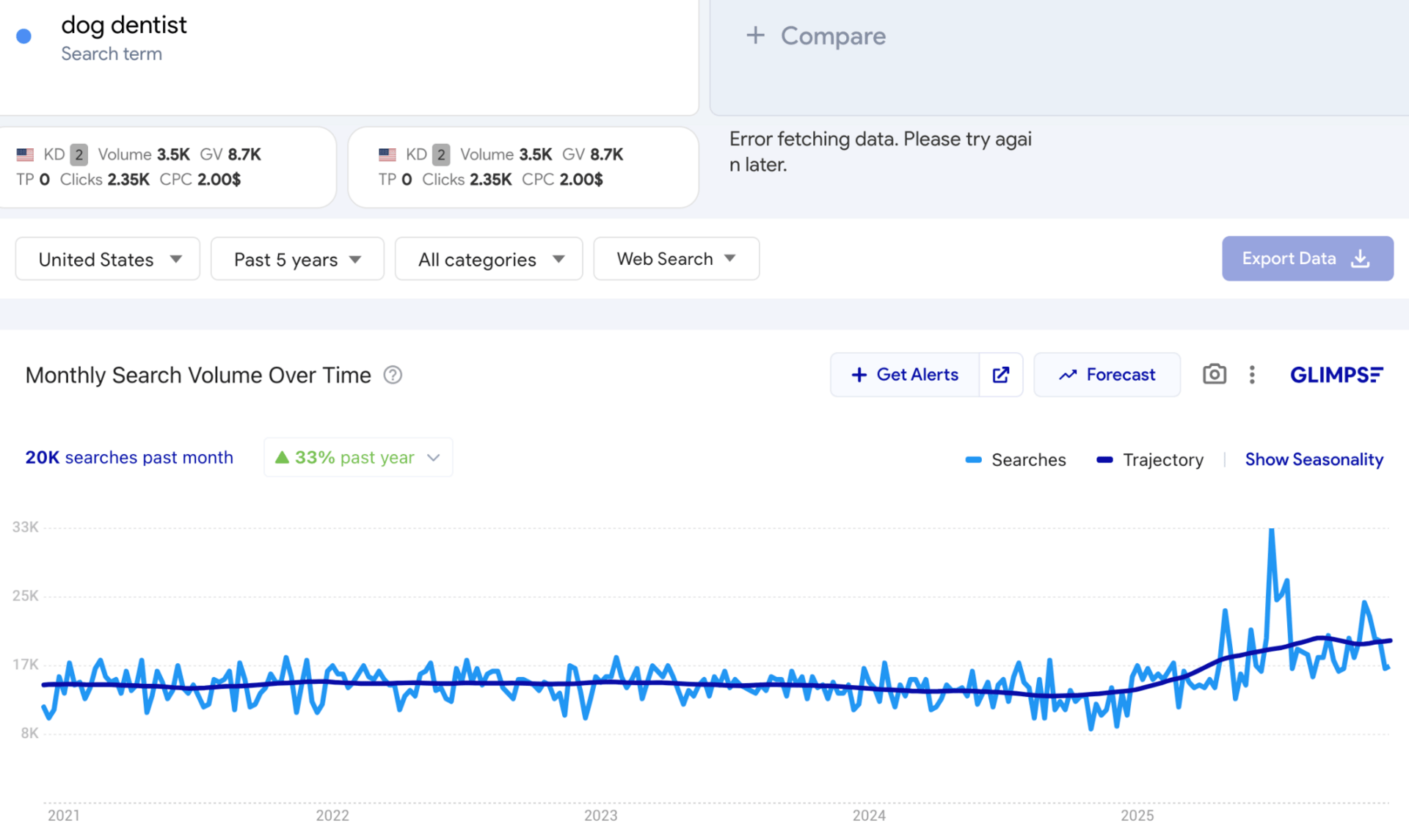
“Dog dentist” search demand was flat and niche for years, then inflected hard in the last 12–18 months, with ~33% YoY growth and clear momentum heading into 2026. .
Pet owners perhaps are no longer lumping dental care into “the vet visit.” They’re actively searching for specialization, which usually happens when (1) awareness rises, (2) generalists feel insufficient, and (3) price sensitivity increases.
Dental issues are painful, expensive, and recurring. Once owners learn what a dental cleaning or extraction actually costs, they start optimizing the decision instead of deferring it.
The downstream opportunity is bigger than dentistry itself.
This is how niche vet verticals are born; dental-only clinics, mobile dental units, referral-based specialists, and bundled preventive programs.
It also opens the door for dental-specific pet insurance riders or subscription-style coverage (cleanings + X-rays + extractions capped annually), which doesn’t exist meaningfully today.
As human healthcare continues to fragment into specialties, pet care is following — just a few years behind. Search behavior like this is usually the first visible signal that the market is ready.
See you Friday!
